(318) 387-2048

AGGREGATE & PIPE

Meet The Rockyard
Click the buttons below or scroll down to explore our inventory.
R.E. BENTZ, INC CRUSHED GRANITE STONE MATERIALS MEET FEDERAL AND LOUISIANA STATE SPECIFICATIONS.
Base materials are critical in construction and installation when a durable, compact, and structural material is necessary. Such materials are typically found beneath driveways, walkways, roadways, sidewalks, and buildings.
Ballast material, sourced from granite, trap rock, quartzite, dolomite, or limestone, stabilizes railway tracks, supports heavy loads, and prevents vegetation growth.
Discover concrete mixture materials that comply with all ASTM international certification standards, guaranteeing top industry quality and safety.
These products serve various purposes within a project, such as providing essential functionality, meeting specific requirements, and contributing to the overall success of the project.
R. E. Bentz, Inc. proudly provides stone materials from Granite Mountain Quarries. The photos and specifications from Granite Mountain Quarries are displayed below.
Base Materials
Base materials are critical in construction and installation when a durable, compactable, and structural material is necessary. Such materials are typically found beneath driveways, walkways, roadways, sidewalks, and buildings.

LADOTD Class 2 Base (SB-2) – 1.5″ minus w/fines
-
SB-2 is similar to limestone base but is harder, less dusty and less susceptible to tracking. It is primarily used in driveways, pathways, road bases, parking lots and pipe bedding. Excellent wet weather product.

Class 8 Base – 1″ minus w/fines
-
This product has the same uses as Class 7 (SB-2).

P-209 – 1.5″ minus w/fines
This material is available upon request.
Please contact us for further information.
-
Common uses include airport runways and taxi runways.

Ballast Materials
Ballast material, commonly used for railway infrastructure, is derived from natural deposits. It serves as a stable foundation for tracks, facilitates drainage, supports heavy loads, deters vegetation growth, and enables easier track maintenance. The acronym "AREA" in product descriptions denotes the American Railway Engineering Association.
_edited.jpg)
AREA #4A (D-Ballast) – 2″ to 3/8″ (washed/clean)
-
Primarily used on the rail track, but can also be used for roadways and in concrete. AREA #4 Ballast specifications and ASTM C-33 Size #4.
_edited.jpg)
AREA #5 (C-Ballast) – 1.5″ to 3/8″ (washed/clean)
-
Commonly used in rail yards and for backfilling lateral lines and around pipes. Railroad Ballast is a clean, 100% crushed granite.
Concrete Materials
Concrete is made from a combination of stone, sand, cement, and water, and the stone used in concrete is called aggregate:
-
Aggregate
The stone and sand used in concrete are also known as coarse and fine aggregates, respectively. Aggregates are typically crushed rocks or coarse gravel, such as limestone or granite, combined with sand.
_edited.jpg)
ASTM #57 – 1.5″ to 3/8″ (washed/clean)
-
This product is commonly used in concrete mixes, asphalt base mixes, for retaining wall drainage, driveways, landscaping and drainage trenches.

ASTM #67 – .75″ to #8 (washed/clean)
-
Primarily used in concrete and asphalt mixes, but can also be used in drainage applications. Sizes from 3/4” down to fine particles.
ASTM #4 – 2″ to 3/8″ (washed/clean)
-
This product has the same uses as AREA #4. It is primarily used on rail tracks but can also be used on roadways.
Construction Materials
Ballast material, commonly used for railway infrastructure, is derived from natural deposits. It serves as a stable foundation for tracks, facilitates drainage, supports heavy loads, deters vegetation growth, and enables easier track maintenance. The acronym "AREA" in product descriptions denotes the American Railway Engineering Association.

Industrial Sand (Screening) – 3/8″ minus w/fines (washed)
-
Commonly used in asphalt. Industrial sand is also used in the production of abrasives, absorbents, ceramics, chemicals, fracking fluid, electronics, filtration media, glass, paint and metal castings.

Rip-Rap #1 – 6″ to 18″
-
Rip-rap is man-placed rock or other material used to armor shorelines, streambeds, bridge abutments, pilings and other shoreline structures against scour and water, wave or ice erosion.

Rip-Rap #2 – 6″ to 24″
-
Rip-rap is an easy-to-use method for decreasing water velocity and preventing erosion. It also improves water quality by increasing roughness and decreasing the velocity of the flow, inducing settling.

A-Stone – 12″ minus
-
This product is commonly used the same way as our rip-rap stone but is smaller.

B-Stone – 6″ minus
-
Granular B gravel is a blend of sand and stone used as a base material for building roadways, parking areas and driveways, and as backfill around concrete walls.
_edited.jpg)
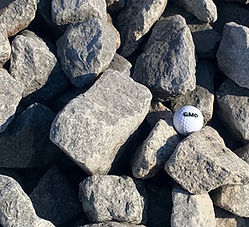
Stone Backfill – 6″ to 1.5″
-
Commonly used in wet areas and drainage ways.